Digital Vignettes vs. Physical Stickers: Which Option Should You Choose in 2024?

James Whitfield
25 June 2026
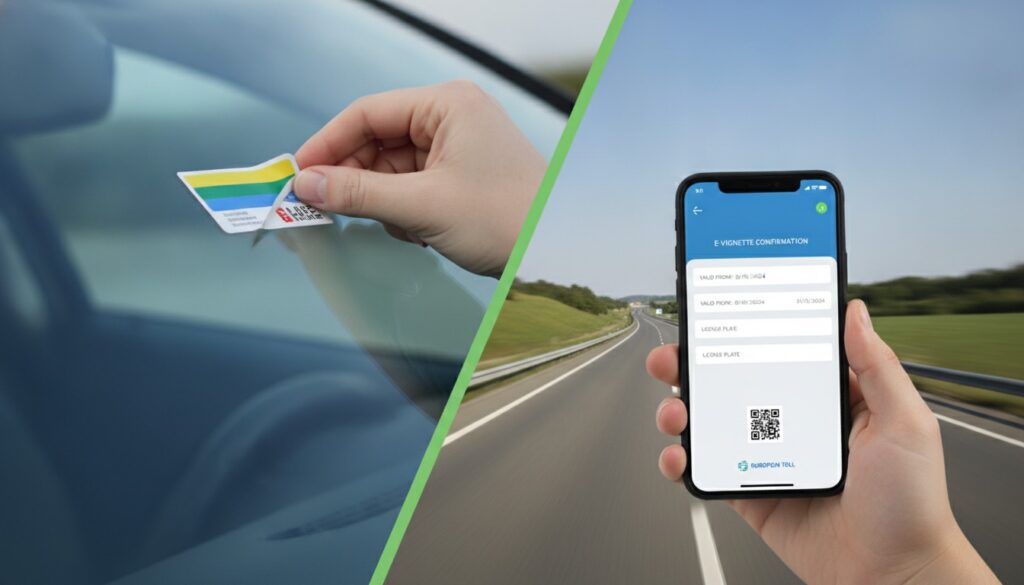
Digital Vignettes vs. Physical Stickers: Which Option Should You Choose in 2024?
Introduction
If you’re planning a road trip across Europe in 2024, you’ve likely encountered the term vignette — a toll sticker or permit required to drive on motorways and expressways in several countries. For decades, the traditional approach involved purchasing a physical sticker and affixing it to your windshield. But times are changing. An increasing number of European nations are transitioning to digital e-vignettes, which are linked directly to your vehicle’s license plate number rather than a physical adhesive label.
So which option is better? Should you stick with the tried-and-true windshield sticker, or embrace the convenience of a digital vignette? In this comprehensive guide, we’ll compare both options across multiple countries, covering pricing, convenience, validity periods, enforcement, and potential pitfalls — so you can make the best decision for your next European journey.
What Is a Vignette and Why Do You Need One?
A vignette is essentially a road toll permit that grants you the right to use a country’s motorway and expressway network for a specified period. Unlike distance-based tolls (where you pay per kilometer at toll booths), vignettes operate on a time-based system — you purchase access for a set duration, whether that’s 10 days, one month, or an entire year.
Countries that currently use a vignette system include:
- Austria (digital since November 2023)
- Switzerland (physical sticker, with digital option introduced in August 2023)
- Czech Republic (fully digital since 2021)
- Hungary (fully digital since 2008)
- Slovenia (digital since February 2022)
- Slovakia (fully digital since 2016)
- Romania (fully digital)
- Bulgaria (fully digital)
- Moldova (digital vignette system)
- Tangible proof: You have a visible, physical confirmation on your windshield that you’ve paid the toll.
- No technology required: You don’t need internet access, a smartphone, or an email address to purchase one.
- Immediate availability: Buy it at a gas station near the border and stick it on — you’re ready to go.
- Familiar process: Many drivers, especially those who have been traveling in Europe for years, are comfortable with this system.
- Difficult to remove: Many physical vignettes are designed to be tamper-proof, meaning they tear apart when you try to remove them. This can leave sticky residue on your windshield.
- Risk of damage or loss: If your windshield cracks and needs replacement, your vignette is destroyed — and you’ll need to buy a new one.
- Fraud risk: Counterfeit stickers have been a problem in some countries, and purchasing from unauthorized sellers can leave you with an invalid vignette.
- Limited purchase locations: If you arrive at a border late at night, the sales point may be closed.
- Environmental concerns: Millions of adhesive stickers generate unnecessary waste each year.
- Official government websites (e.g., eznamka.sk for Slovakia, ematrica.hu for Hungary)
- Authorized third-party platforms that offer a streamlined purchasing experience
- Mobile apps provided by national toll operators
- Some gas stations and retail points that issue digital vignettes
- Convenience: Purchase from anywhere in the world, at any time — even weeks before your trip. No need to stop at a border crossing.
- No windshield clutter: Your windshield stays clean. No sticker, no residue, no obstruction.
- Instant activation or scheduled start: Many systems allow you to choose a future start date, giving you flexibility in planning.
- No risk of physical damage: Since there’s nothing on your windshield, a cracked or replaced windshield doesn’t affect your vignette.
- Environmentally friendly: No paper, no adhesive, no waste.
- Easy record-keeping: You receive a digital confirmation via email, which you can store on your phone or print out.
- Requires accurate registration data: If you enter your license plate number incorrectly — even by a single character — your vignette is invalid, and you could face a fine.
- Internet access needed: You need a device with internet access to purchase the vignette online.
- Potential for scam websites: Unofficial websites sometimes charge inflated prices or fail to register your vignette properly. Always use official or verified platforms.
- No physical proof at the roadside: While enforcement is automated, some drivers feel uneasy without a visible sticker. In rare cases, manual checks may require you to show your email confirmation.
- System outages: Though rare, technical issues with the national database could temporarily affect validation.
- Digital vignette: Available since November 2023 via the ASFiNAG website and app.
- Physical sticker: Still available at gas stations, post offices, and ADAC/ÖAMTC offices.
- Pricing (2024): 10-day vignette: €8.60 | 2-month: €25.70 | Annual: €96.40
- Key note: The digital vignette becomes valid 18 days after purchase to prevent fraud, so plan ahead. The physical sticker is valid immediately.
- Digital vignette: Introduced in August 2023 alongside the traditional sticker.
- Physical sticker: Still widely used and available at border crossings, gas stations, and post offices.
- Pricing (2024): CHF 40 (approximately €42) for an annual vignette — the only duration available.
- Key note: Switzerland only offers an annual vignette (valid from December 1 of the previous year to January 31 of the following year). No short-term options exist.
- Digital only: Since January 2021, the Czech Republic has been fully digital. No physical stickers are issued.
- Pricing (2024): 10-day: CZK 310 (~€12.50) | 30-day: CZK 440 (~€17.80) | Annual: CZK 2,300 (~€93)
- Key note: Purchase exclusively online at edalnice.cz or through authorized resellers.
- Digital only: Hungary was a pioneer, going fully digital back in 2008.
- Pricing (2024): 10-day: HUF 5,420 (~€14) | Monthly: HUF 5,790 (~€15) | Annual: HUF 57,050 (~€148)
- Key note: The system is mature and reliable. Purchase via ematrica.hu or at gas stations that issue e-vignettes.
- Digital only: Fully digital since February 2022.
- Pricing (2024): 7-day: €15 | 30-day: €30 | Annual: €110
- Key note: Slovenia switched from physical stickers to a weekly (rather than 10-day) short-term option.
- Digital only: All three countries operate fully digital vignette systems.
- Key note: Purchase through official national portals and always verify your license plate details.
- Typos in the license plate number (e.g., entering “0” instead of “O”)
- Missing or incorrect country code (e.g., forgetting the “D” prefix for Germany)
- Rental car confusion — the plate on the car may differ from what the rental company communicated
- Temporary plates or dealer plates that aren’t recognized by the system
- Triple-check your license plate before confirming the purchase.
- Take a photo of your license plate and compare it character by character with your vignette confirmation.
- Save your confirmation email and keep a printed copy in the car.
- Contact the issuing authority immediately if you discover an error — some countries allow corrections within a limited window.
- For rental cars, confirm the exact license plate number with the rental company before purchasing a vignette.
- You want to purchase in advance from home
- You prefer a clean windshield without stickers
- You’re comfortable with online purchases and can double-check your registration details
- You’re traveling to a country that only offers digital vignettes (Czech Republic, Hungary, Slovenia, Slovakia, Romania, Bulgaria)
- You prefer tangible proof of payment on your windshield
- You’re not comfortable with online transactions
- You want immediate validity without waiting periods (relevant for Austria)
- The country still offers physical stickers (Austria, Switzerland)
- Digital vignettes offer unmatched convenience but require accurate license plate entry
- Physical stickers provide visible proof but are being phased out in most countries
- Always purchase from official or verified sources to avoid scams and overcharges
- Double-check your vehicle registration details — a single typo can cost you hundreds of euros in fines
- Plan ahead, especially for Austria’s 18-day digital vignette activation delay
Important: Driving on a motorway without a valid vignette can result in hefty fines ranging from €120 to over €800, depending on the country. In some cases, your vehicle can even be impounded.
Physical Stickers: The Traditional Approach
How Physical Stickers Work
Traditional vignettes are adhesive stickers that you purchase at border crossings, gas stations, post offices, or authorized retailers. Once bought, you peel off the backing and attach the sticker to the inside of your windshield, typically in the upper-left or upper-right corner. The sticker displays the validity period and is color-coded by duration.
Advantages of Physical Stickers
Disadvantages of Physical Stickers
Pro Tip: If you’re using a physical sticker, always keep your purchase receipt. In the event of a windshield replacement or a dispute, the receipt serves as your backup proof of purchase.
Digital E-Vignettes: The Modern Alternative
How Digital Vignettes Work
A digital e-vignette is a virtual toll permit linked to your vehicle’s license plate number. There’s nothing to stick on your windshield. Instead, your registration details are stored in a central database, and enforcement is carried out using automatic number plate recognition (ANPR) cameras installed along motorways and at border crossings.
You can typically purchase a digital vignette through:
Advantages of Digital Vignettes
Disadvantages of Digital Vignettes
Warning: One of the most common mistakes travelers make is entering the wrong license plate number when purchasing a digital vignette. Always double-check your registration details, including the country code prefix, before completing your purchase.
Country-by-Country Comparison: Digital vs. Physical in 2024
Here’s a breakdown of how major European vignette countries handle the digital vs. physical question in 2024:
Austria
Switzerland
Czech Republic
Hungary
Slovenia
Slovakia, Romania, Bulgaria
What Happens If Your Registration Details Don’t Match?
This is one of the most critical issues with digital vignettes. Since enforcement relies entirely on ANPR cameras reading your license plate and matching it against the database, any discrepancy can result in a fine — even if you’ve legitimately paid.
Common problems include:
How to Protect Yourself
Pricing Comparison: Are Digital Vignettes Cheaper?
In most countries, the price is identical whether you buy a digital or physical vignette. The format doesn’t affect the cost — you’re paying for the same road access.
However, be cautious of third-party reseller markups. Some websites charge a “service fee” or “processing fee” on top of the official price. While these platforms may offer added convenience (such as multi-country bundles or multilingual support), you should always compare their prices against the official government portal to understand exactly what you’re paying.
Money-Saving Tip: If you’re crossing multiple vignette countries on a single trip, plan your route carefully. Sometimes a slight detour can save you from purchasing an additional vignette for a country you’d only pass through briefly.
Which Option Should You Choose?
The answer depends on your travel style, comfort with technology, and itinerary:
Choose a digital vignette if:
Conclusion
The shift from physical stickers to digital e-vignettes represents a broader trend toward smarter, more efficient toll collection across Europe. While physical stickers still have their place — particularly in Austria and Switzerland — the future is undeniably digital. Countries like Hungary, the Czech Republic, and Slovenia have already proven that fully digital systems work reliably and efficiently.
Whichever option you choose, the most important thing is to have a valid vignette before entering the motorway. The fines for non-compliance are steep, and ignorance of the requirement is never accepted as an excuse.
Key takeaways:
Ready to Hit the Road?
Don’t let vignette confusion slow down your European adventure. Research your route, identify which countries require vignettes, and purchase them in advance through official channels. Bookmark this guide for quick reference, and share it with fellow travelers who might find it useful.
Safe travels and happy driving across Europe in 2024!