A Complete Guide to European Toll Roads: How They Actually Work

James Whitfield
25 June 2026
A Complete Guide to European Toll Roads: How They Actually Work
Imagine this: you’ve just landed in Europe, picked up your rental car, and you’re ready to hit the open road. Then you encounter your first toll station — a maze of lanes, unfamiliar signs, and payment machines that don’t seem to accept your credit card. Sound familiar? You’re not alone.
European toll roads are notoriously confusing for first-time visitors, and even seasoned travelers can find themselves caught off guard when crossing from one country’s system into another. Unlike North America, where toll systems share a degree of uniformity, Europe is a patchwork of wildly different toll models, each with its own rules, payment methods, and quirks.
This comprehensive guide will walk you through everything you need to know about European toll roads — from barrier-based motorways in France and Italy to vignette sticker systems in Austria and Switzerland, and the increasingly common free-flow electronic tolling found in Portugal and beyond. By the end, you’ll be navigating Europe’s highways like a local.
Understanding the Three Main Toll Models in Europe
Before diving into country-specific details, it’s essential to understand that European toll systems generally fall into three broad categories. Knowing which model a country uses will save you time, money, and a lot of frustration.
1. Barrier-Based (Ticket) Tolling
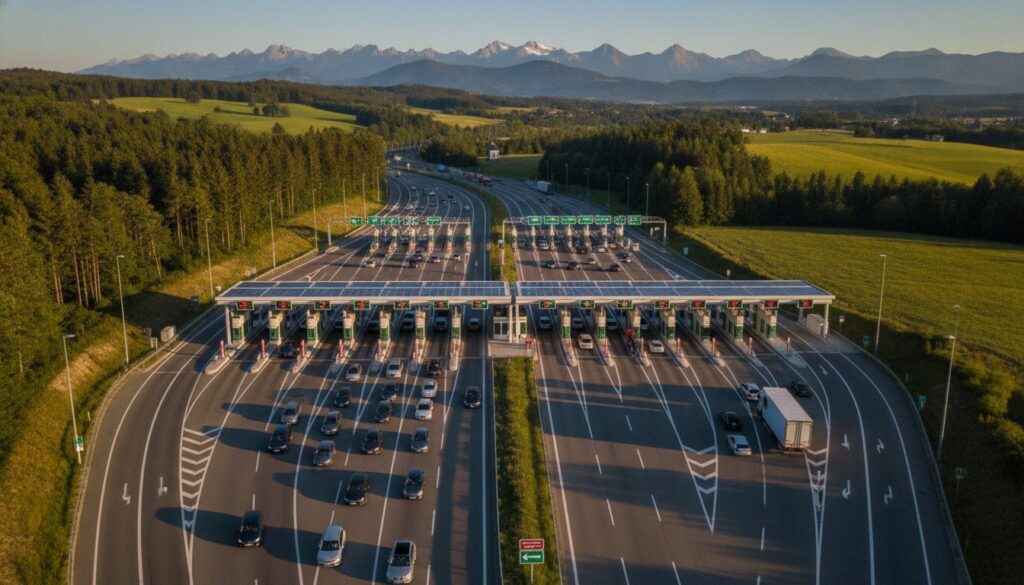
This is the most traditional and arguably the most intuitive system. You’ll encounter physical toll plazas where you either:
- Take a ticket when entering the motorway and pay when you exit (distance-based)
- Pay a fixed fee at a single toll point (flat-rate)
- You pay a flat fee regardless of how far you drive
- The vignette must be displayed on your windshield (or registered digitally to your license plate)
- Driving without a valid vignette can result in hefty fines — sometimes €200 or more
- A Via Verde transponder (available for rent at border stations and airports)
- Your license plate, which is then matched to a pre-registered payment method
- France — Barrier tolls; Liber-t transponder available; expensive on long routes
- Italy — Barrier tolls; Telepass available; watch for ZTL zones in cities
- Spain — Mix of toll and free motorways (autopista vs. autovía); barrier system
- Portugal — Free-flow electronic tolling on many routes; rent a Via Verde device
- Germany — No tolls for cars on the Autobahn (trucks only); enjoy it while it lasts
- Austria — Digital vignette system; extra tolls for tunnels and alpine passes
- Switzerland — Annual vignette only (CHF 40); additional tunnel fees
- Czech Republic — Electronic vignette; purchase online before arrival
- Hungary — Electronic vignette (e-matrica); buy online or at gas stations
- Croatia — Barrier tolls; ENC transponder for electronic payment
- Norway — Free-flow electronic tolling (AutoPASS); register your vehicle online
- UK/England — Dart Charge (Dartford Crossing) and Clean Air Zones; pay online
- Research the countries on your route — Know which toll model each country uses before you arrive
- Pre-purchase digital vignettes — For countries like Austria, Hungary, and Czech Republic, buy your vignette online and save time at the border
- Register your license plate — In Portugal and Norway, register your vehicle online and link a payment method before you drive
- Check your rental car agreement — Many rental companies offer toll transponders (like Telepass, Liber-t, or Via Verde) as add-ons. While they come with a daily fee, they can save enormous hassle
- Stay in the correct lane at barrier toll stations. Look for signs indicating cash (espèces, contanti), card, or electronic payment lanes. The “T” or transponder lanes are for electronic pass holders only — entering without one can trigger fines or barriers that won’t open
- Keep small bills and coins in your local currency. Some older toll machines don’t give change or accept large denominations
- Download a toll calculator app — Services like ViaMichelin, Tollsmart, or Google Maps (with toll pricing enabled) can estimate your total toll costs before you set off
- Save your receipts — If you’re traveling for business, toll receipts are typically tax-deductible. Even for personal travel, receipts can help resolve disputes
- Don’t ignore toll notices. European countries increasingly share enforcement data across borders. Unpaid tolls from Portugal, France, or Italy can result in collection letters — or worse, issues when you next enter the country
- Don’t assume your credit card will work everywhere. American-style magnetic stripe cards are often rejected. A chip-and-PIN card is essential
- Don’t forget about city congestion charges. London, Stockholm, Milan, and several Norwegian cities charge vehicles for entering central zones. These are separate from motorway tolls and easy to overlook
Pro Tip: Always keep cash (in the local currency) and a chip-and-PIN credit card handy at barrier toll stations. Many automated lanes do not accept magnetic-stripe-only cards or contactless payments.
Countries using this model: France, Italy, Spain, Portugal (partially), Poland (partially), Croatia, Greece, and Turkey.
In France, for example, you’ll pull a ticket from a machine as you enter the péage (toll road). When you exit, you insert the ticket and pay based on the distance traveled. Costs can add up quickly — a drive from Paris to Nice can cost over €70 in tolls alone. France also offers the Liber-t electronic transponder for frequent users, which lets you breeze through dedicated lanes without stopping.
In Italy, the system works similarly through the Autostrada network. You take a ticket at entry, and the toll is calculated upon exit. Italy also offers the Telepass electronic device, which is extremely popular among locals and can be rented by tourists through various services.
2. Vignette (Sticker) Systems
Several European countries use a vignette system, where you purchase a sticker (or increasingly, a digital equivalent) that grants you access to the motorway network for a set period — typically 10 days, one month, or one year.
In Switzerland, the annual motorway vignette costs CHF 40 (approximately €42) and is mandatory for all vehicles using the national motorway network. There is no shorter-duration option — even if you’re just passing through for a day, you need the full annual sticker.
Austria has modernized its system with the digitale Vignette, which you can purchase online and is linked to your license plate. This is a game-changer for rental car users who don’t want to deal with physical stickers. A 10-day vignette costs around €9.90 for cars.
Important: In countries with vignette systems, certain tunnels and special routes (like the Brenner Pass in Austria or the Great St. Bernard Tunnel between Switzerland and Italy) often require additional separate tolls on top of the vignette.
3. Free-Flow Electronic Tolling
This is the most modern — and potentially the most confusing — system for visitors. There are no physical barriers or toll booths. Instead, overhead gantries equipped with cameras and sensors automatically detect your vehicle and charge your account.
Countries using this model: Portugal (Via Verde), England (Dart Charge, Clean Air Zones), parts of Norway, Sweden (congestion charges), and increasingly sections of other countries.
In Portugal, the free-flow system can be particularly bewildering. After the country removed physical toll booths from many motorways, drivers now pass under electronic gantries that read either:
Country-by-Country Quick Reference
Here’s a practical breakdown of what to expect in the most-visited European countries:
Did You Know? Germany’s Autobahn remains one of the last major toll-free motorway networks in Europe for passenger vehicles. However, there have been ongoing discussions about introducing a car toll system in the future.
Practical Tips for Navigating European Tolls Like a Pro
Now that you understand the systems, here are actionable tips to make your European road trip as smooth as possible:
Before You Leave Home
On the Road
Common Mistakes to Avoid
How Much Should You Budget for Tolls?
Toll costs vary dramatically depending on your route. Here are some real-world examples to help you budget:
| Route | Distance | Approximate Toll Cost |
|—|—|—|
| Paris to Nice (France) | ~930 km | €70–€80 |
| Milan to Naples (Italy) | ~770 km | €45–€55 |
| Lisbon to Algarve (Portugal) | ~280 km | €20–€25 |
| Calais to Paris (France) | ~290 km | €20–€25 |
| Zagreb to Dubrovnik (Croatia) | ~600 km | €25–€30 |
| Vienna to Salzburg (Austria) | ~300 km | €9.90 (vignette) |
Prices are approximate and subject to change. Always verify current rates before traveling.
For a two-week road trip covering multiple countries, it’s reasonable to budget €150–€300 for tolls alone, depending on your itinerary and how much motorway driving you plan to do.
Money-Saving Tip: In countries like Spain and France, you can often take parallel national roads (N-roads) instead of toll motorways. They’re slower but free, and they often pass through charming towns and scenic countryside. It’s a trade-off between time and money — and sometimes the scenic route is the better choice.
The Future of European Tolling
Europe is gradually moving toward unified electronic tolling. The European Union has been working on the European Electronic Toll Service (EETS), which aims to allow drivers to use a single on-board device across all EU member states. While full implementation is still a work in progress, several cross-border interoperability agreements are already in place.
Additionally, many countries are shifting from distance-based tolling to emissions-based pricing, where cleaner vehicles pay less. This trend aligns with Europe’s broader push toward sustainability and is something to watch if you’re planning future trips.
Conclusion
European toll roads don’t have to be intimidating. Once you understand the three main models — barrier-based, vignette, and free-flow electronic — the system starts to make sense. The key is preparation: research your route, pre-purchase vignettes, consider renting a transponder with your car, and always carry a chip-and-PIN payment card.
Remember that toll costs are a real part of your travel budget, especially on longer routes through France, Italy, and the Iberian Peninsula. Factor them in when planning your itinerary, and don’t be afraid to mix motorway driving with scenic national roads to save money and discover hidden gems along the way.
With the right knowledge and a little advance planning, you’ll navigate Europe’s toll roads with confidence — no matter how many borders you cross.
Ready to Hit the Road?
Planning a European road trip? Bookmark this guide for quick reference, and share it with your travel companions so everyone’s on the same page. Have a toll road tip or experience to share? Drop it in the comments below — your insight could save a fellow traveler from a costly mistake!
Safe travels, and happy driving across Europe!